
Relationship Self-Assessment: Is Your Relationship Ready to Heal?
Updated: 2 days ago
Most couples who reach out for help have already spent months, sometimes years, circling the same arguments without resolution. Before booking a session or starting any kind of healing process, there is one question that matters more than any other: are both of you actually ready? A honest relationship self-assessment is not a test you pass or fail. It is a structured way to see your relationship clearly, identify what is genuinely broken versus what is temporarily strained, and decide whether the conditions for real change are in place. This guide walks you through exactly that process.
Table of Contents
Why Self-Assessment Matters Before You Seek Help
Couples therapy in Singapore, and anywhere else, works best when both partners arrive with a minimum level of self-awareness and willingness. Without that baseline, even the most skilled coach is working against the current. A relationship self-assessment gives you that baseline. It surfaces the specific patterns, blind spots, and unspoken fears that are driving conflict before you spend a single hour in a session.
Self-assessment also shifts the mindset. Coming to couples therapy as a passive participant, expecting the coach to "fix" your partner, is one of the most common reasons people leave without meaningful change. A proper assessment forces each person to examine their own contributions to the dynamic, which is the starting point for every productive session.
In practice, couples who complete a structured self-assessment before starting work with a relationship coach tend to move faster and report clearer goals. They know what they are there for, rather than spending the first several sessions just establishing what the problem is.
Quick Takeaways
Key Insight | Explanation |
|---|---|
Both partners must be willing, not just present | Physical attendance at counseling means nothing without genuine willingness to examine your own behavior. Dragging a reluctant partner rarely leads to lasting change. |
Conflict frequency is not the same as relationship health | Some couples fight often but repair well. Others rarely argue but have drifted into emotional numbness. The quality of repair matters more than the number of conflicts. |
Emotional safety is a prerequisite, not a reward | Healing cannot begin while either partner feels consistently unsafe to speak honestly. Establishing basic psychological safety is the first task, not an end goal. |
Trust can be rebuilt, but only with transparency and time | Broken trust, including after infidelity, does not automatically heal with time alone. It requires consistent, transparent action from the partner who broke it. |
Readiness exists on a spectrum for each individual | Research on behavior change shows people move through stages from not yet seeing a problem to actively making changes. Both partners are rarely at the same stage simultaneously. |
Past emotional wounds distort current conflicts | Unresolved personal trauma, often from childhood or previous relationships, frequently amplifies present-day disagreements far beyond their actual weight. |
A self-assessment is a direction-finder, not a verdict | Low scores in any area signal where work is needed, not that the relationship is over. Every identified gap is a specific target for growth. |
Before examining the specific assessment questions, it helps to understand the five domains that any serious relationship self-assessment must address. These are not arbitrary categories. They represent the areas where couples most frequently get stuck, and where change has the greatest compound effect on overall relationship health.
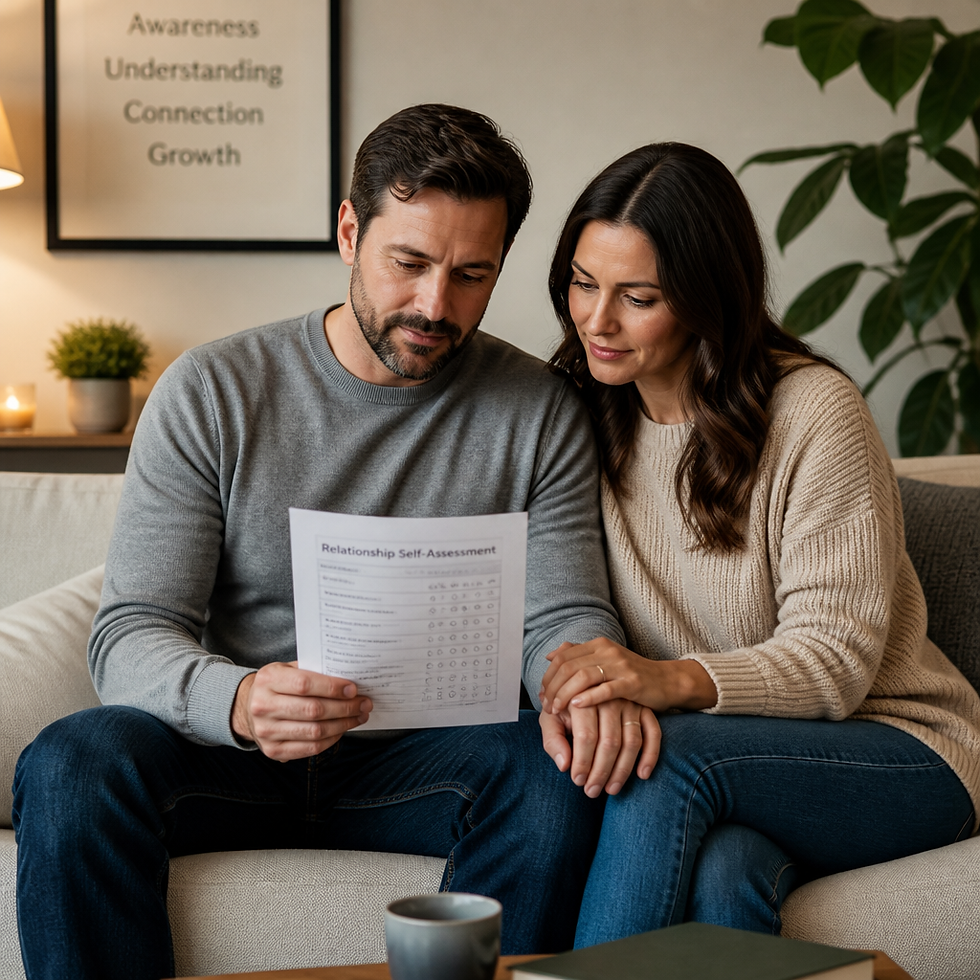

The Five Domains Every Relationship Self-
Assessment Must Cover
Domain 1: Communication Quality
This is not about how often you talk. It is about whether your conversations lead anywhere productive. Couples with poor communication quality often speak at each other rather than to each other. They interrupt, they assume, and they respond to what they feared was meant rather than what was actually said. A key marker here is whether disagreements typically escalate, stall in defensiveness, or actually move toward some form of resolution.
Healthy communication does not require perfection. It requires a basic repair mechanism: the ability for either partner to stop a conversation that has gone sideways and re-enter it more constructively. If no such mechanism exists in your relationship, this is the first domain to address.
Domain 2: Trust and Emotional Safety
Emotional safety means you can say something difficult and trust it will be received with care rather than weaponized later. Without it, partners begin self-censoring, which creates distance that accumulates silently over time. Trust is built incrementally through consistent, predictable behavior. It is damaged just as incrementally, through small betrayals, broken commitments, and dismissed feelings.
This domain is particularly relevant for couples dealing with infidelity or repeated let-downs. Rebuilding trust is possible, but it requires the offending partner to actively create conditions for it, not simply to wait for the other person to "get over it."
Domain 3: Emotional Intimacy and Connection
Many couples in Singapore present for couples therapy not because they fight constantly, but because they feel like strangers who share a flat and a schedule. Emotional intimacy is the sense that your partner truly knows and values who you are, not just your functional role in the household. When this erodes, partners often describe feeling invisible or perpetually misunderstood.
Domain 4: Individual Wellbeing and Personal Accountability
No relationship can be healthier than its least well individual in it. If one or both partners are carrying significant anxiety, depression, unresolved grief, or trauma responses, those states will hijack the relationship regardless of how good the communication strategies are. Individual wellbeing is not a separate issue from the relationship; it is foundational to it.
Domain 5: Shared Purpose and Future Vision
Couples who can articulate what they are working toward together, not just what they are trying to stop doing, have a significantly easier path through therapy. A shared vision does not have to be elaborate. It can be as simple as "we want to stop dreading coming home" or "we want our children to see what a healthy relationship looks like." The presence or absence of this shared forward orientation tells you a great deal about where the relationship currently stands.
Readiness to Change: The Factor Most Couples Overlook
Research on behavioral change, built on the Transtheoretical Model developed by Prochaska and DiClemente, identifies distinct stages through which people move before they genuinely adopt new behaviors. These stages include precontemplation, contemplation, preparation, action, and maintenance. The same framework applies to couples considering relationship therapy.
In the precontemplation stage, a partner does not yet acknowledge that their own behavior contributes to the problem. They may attend sessions under pressure but resist change internally. In the contemplation stage, they recognize there is a problem but are ambivalent about whether changing is worth the effort. Only at the preparation and action stages does meaningful therapeutic work become possible.
The most common reason couples therapy fails is not that the tools are wrong or the coach is unskilled. It is that one or both partners arrive at the preparation stage before they have genuinely moved out of precontemplation.
A key insight from this research is that most people entering couples work are in the early stages of change, and men statistically tend to enter at earlier stages than women. This is not a character flaw. It is a recognizable pattern, and a skilled relationship coach in Singapore will work with it directly rather than pretending it is not there. If one partner is in precontemplation and the other is ready for action, the assessment should flag this gap so it can be addressed first.
Pro tip: I urge if you are considering couples therapy but your partner is reluctant, do not frame it as "therapy." Frame it as a structured conversation with a neutral third party. Many partners who resist the word "therapy" are entirely open to the idea of having someone help them communicate more clearly. The initial framing often determines whether a reluctant partner will attend at all.
The Assessment: 20 Honest Questions to Ask Right Now
Work through these questions individually, ideally in writing, before sharing your answers with your partner. Honesty with yourself is more important than presenting a positive picture to your partner. Rate each item from 1 (rarely or never true) to 5 (consistently true).
Communication
1. When I raise a concern, my partner listens without immediately becoming defensive. 2. I can tell my partner something that upset me without fearing their reaction. 3. After an argument, we are able to return to the topic and reach some kind of resolution. 4. I feel heard, not just heard at.
Trust and Safety
5. I trust my partner to follow through on what they say they will do. 6. I do not feel the need to check my partner's phone, location, or activities regularly. 7. When I am vulnerable with my partner, I do not regret it afterward. 8. My partner does not use things I have shared against me during arguments.
Emotional Intimacy
9. I feel genuinely known by my partner, not just tolerated or managed. 10. We have moments of real connection and warmth, even amid difficulties. 11. I know what my partner's current fears, dreams, or pressures are. 12. My partner knows mine.
Individual Readiness
13. I am willing to examine my own role in our recurring conflicts. 14. I can name at least two behaviors of my own that I want to change. 15. I am open to the possibility that some of what upsets me in my partner reflects unresolved wounds I carry. 16. I am seeking help to improve the relationship, not to build a case against my partner.
Shared Future
17. When I imagine the future, my partner is in it. 18. I believe this relationship is worth the effort healing requires. 19. We share at least some agreement on what a good relationship between us would look like. 20. I am prepared to show up consistently, not just in sessions but between them.

Reading Your Results: What Your Answers Actually Mean
Scores 85 to 100: Strong Foundation with Specific Gaps
You and your partner have meaningful strengths to build on. The lower-scoring areas represent specific, targetable issues rather than systemic breakdown. At this stage, a short structured engagement with a relationship coach, focused on the low-scoring domains, will typically produce rapid, lasting results. Do not wait until the score drops. Addressing issues when the foundation is still strong is significantly easier than rebuilding after it has eroded.
Scores 60 to 84: Genuine Effort Required but Recovery is Realistic
This is the range where most couples seeking couples therapy in Singapore fall when they first make contact. There are real problems in multiple domains, but there are also genuine strengths, and both partners can usually articulate what they miss about the relationship. This is recoverable territory, but it requires structured, consistent work. Short-term fixes will not hold. The process needs to go deep enough to address the underlying patterns, not just the surface behaviors.
Scores 40 to 59: Deep Work Needed, Individual Sessions May Precede Couples Work
At this level, one or both partners often carry significant individual wounds that are heavily influencing the relationship dynamic. Trying to do couples work without first addressing those individual blocks is like trying to build on unstable ground. A skilled coach will typically recommend a combination of individual and couples sessions, using tools such as NLP or hypnotherapy to work through personal barriers that couples-focused conversation alone cannot reach.
Scores Below 40: Safety and Stabilization Must Come First
If your score falls in this range, the priority is not relationship growth but relationship stabilization. If there is any element of emotional or physical harm present, individual support and safety planning take precedence over couples work. A professional assessment in person is necessary before any joint sessions begin.
Pro tip: I advise do this assessment separately and honestly, then compare your scores by domain, not just overall. A significant gap between partners in the "Individual Readiness" domain (questions 13 to 16) is actually more useful information than a low overall score. It tells you exactly what needs to happen first before the couples work can begin.
Three Approaches to Relationship Healing Compared
Approach | Best For | Key Limitation |
|---|---|---|
Talk-based couples counseling only | Couples with good baseline communication who need a structured space to address specific conflicts | Can stall when deep emotional blocks or past trauma are driving patterns that conversation alone cannot shift |
Individual therapy before or alongside couples work | Couples where one or both partners carry significant personal wounds, anxiety, or unresolved grief that distorts the relationship dynamic | Progress in individual sessions may not transfer to couple dynamics without coordinated joint work |
Integrated coaching using NLP, hypnotherapy, and personalized counseling | Couples who have tried conventional talk therapy without lasting results, or where deep subconscious patterns are driving recurring conflict | Requires a practitioner with genuine multi-modal expertise; less effective if techniques are applied as a formula rather than tailored to the specific couple |
When Self-Assessment Points to Professional Support
A self-assessment is a starting point, not a finishing line. It is designed to surface information, not to resolve it. The following signs consistently indicate that self-guided work is not sufficient and that professional support, specifically a qualified relationship coach in Singapore with experience in complex dynamics, is the appropriate next step.
You Keep Having the Same Argument
If you can predict exactly how a disagreement will unfold, including which points each person will make, how it will escalate, and how it will end without resolution, you are caught in a pattern, not having a conflict. Patterns do not break through willpower or conversation. They require someone trained to see what is maintaining the pattern and intervene at that level.
One Partner Has Already Emotionally Withdrawn
Emotional withdrawal is often more serious than open conflict. A partner who has stopped arguing is not a partner who has accepted the situation. They are frequently a partner who has already begun grieving the relationship. This state responds poorly to standard communication exercises because the withdrawn partner is no longer invested enough to practice them. Addressing the withdrawal is the first clinical task.
There Has Been a Specific Breach of Trust
Infidelity, financial deception, or significant broken promises require a structured framework for rebuilding trust, not simply time and good intentions. The injured partner needs their experience genuinely validated. The partner who caused the breach needs to understand exactly what rebuilding requires of them. Both needs are difficult to meet in an unstructured, self-directed process.
The Self-Assessment Reveals Significant Score Gaps Between Partners
If your answers and your partner's answers differ dramatically across multiple domains, that gap itself is important clinical information. It means you are not yet looking at the same relationship. A skilled coach will work to establish a shared reality first, as a foundation for everything that follows.
If you are in Singapore and any of the above resonates, the next step is a structured intake conversation with a qualified professional who can review your self-assessment results and provide a personalized roadmap. A good coach will never apply a generic program to your specific situation. Everything that follows, including the combination of techniques used, the pacing of sessions, and the balance of individual and joint work, should be built around what your assessment reveals.
Frequently Asked Questions
What is a relationship self-assessment and why should couples do one?
In my view, a relationship self-assessment is a structured set of questions designed to help each partner honestly evaluate the current state of their relationship across key domains including communication, trust, emotional intimacy, individual readiness, and shared vision. Couples benefit from doing one before starting therapy because it surfaces specific gaps, establishes a baseline, and shifts each partner from a passive "fix us" mindset to an active "here is what I need to work on" orientation. This shift alone significantly improves therapy outcomes.
Can a relationship self-assessment replace couples therapy in Singapore?
No. A self-assessment is a diagnostic tool, not a treatment. It can tell you what needs attention and whether conditions for productive therapy are in place, but it cannot change the underlying patterns. For couples dealing with recurring conflict, broken trust, emotional withdrawal, or deep personal wounds, professional support from a qualified relationship coach or counselor is necessary to do the work the assessment identifies.
What if my partner refuses to do the self-assessment?
Do it yourself anyway. Your own honest answers are enormously useful, both for your personal clarity and as a starting point for a professional intake conversation. A partner's refusal to engage with an assessment is itself meaningful information about where they sit in terms of readiness for change. A skilled coach can work with a reluctant partner, but that work typically starts by addressing the reluctance directly, not by bypassing it.
How is NLP or hypnotherapy used in relationship coaching in Singapore?
Both NLP (Neuro-Linguistic Programming) and hypnotherapy are tools for accessing and reshaping subconscious patterns that drive behavior in ways standard conversation cannot easily reach. In a relationship context, they are particularly useful when one or both partners react to current situations with an intensity that seems disproportionate because the trigger is actually connected to an older wound. These techniques are not magic; they are precision tools, and their effectiveness depends entirely on the skill and experience of the practitioner using them.
How do I know if my relationship has enough foundation left to heal?
The clearest indicator is whether both partners can articulate something genuine they value about the relationship, not just what they want to stop experiencing. If both people still have a real answer to "what do you want this relationship to be?" the foundation exists. Even deeply damaged relationships can heal when both partners are willing to engage with that question honestly. The self-assessment in this article is designed specifically to help you answer it.
Is it normal for one partner to be more ready than the other to start therapy?
Very normal. Research on readiness for change consistently shows that partners in a couple are rarely at the same stage simultaneously. One person typically reaches the "something needs to change" point months or even years before the other. A good relationship coach will address this asymmetry directly in early sessions rather than assuming both partners are starting from the same place. The gap in readiness is workable, but it needs to be named, not ignored.
If this assessment has raised questions you want to explore further, or if you want to share what you discovered about your own relationship, share your experience in the comments below. Contact me for the matter.


Comments