
Multicultural Marriage Singapore: Navigating Differences
Nearly one in five citizen marriages in Singapore is inter-ethnic, and more than a third involve a foreign spouse. Those figures have held steady for a decade, which tells you something important: multicultural marriage in Singapore is not a fringe experience. It is the lived reality of hundreds of thousands of couples. Yet the challenges that come with it, from clashing family expectations to fundamentally different ideas about money, child-rearing, and emotional expression, rarely ease on their own. They tend to deepen quietly, until a small misunderstanding carries the weight of two entirely different worldviews.
Quick Takeaways
Key Insight | Explanation |
|---|---|
19% of Singapore citizen marriages are inter-ethnic | Per Singapore's National Population and Talent Division data for 2025, inter-ethnic unions make up roughly one in five citizen marriages, a figure stable since 2015. |
37% of citizen marriages are transnational | More than a third of Singaporeans marry a foreign spouse, compounding cultural differences with legal, language, and family-distance challenges. |
Communication style is the first flashpoint, not values | Couples often argue about surface events, such as a tone of voice or a missed family dinner, before they name the underlying cultural script driving the conflict. |
In-law expectations are the most commonly reported challenge | Research on intercultural marriages consistently identifies family, not finances or religion, as the most frequently cited source of friction in the early years. |
Parenting is the pressure-test moment | The arrival of a first child forces couples to negotiate religion, language, discipline style, and extended-family involvement all at once, often for the first time explicitly. |
Early counselling outperforms crisis counselling | Couples who address cultural misalignments in the first two years of marriage report better long-term outcomes than those who wait until resentment has accumulated. |
Shared intimacy buffers cultural conflict | Research on intercultural couples in Singapore's context finds that a strong sense of mutual intimacy and understanding is one of the most consistent protective factors. |
Why Cultural Differences Cut Deeper Than Couples Expect
When two people from different cultural backgrounds fall in love, the differences feel exciting, even enriching. The friction comes later, in the mundane rhythm of shared life, when one partner's normal is the other's baffling. Culture is not just a set of traditions you observe at Chinese New Year or Hari Raya. It is a deeply embedded operating system that shapes how you interpret silence, how you handle disagreement, what you owe your parents, and what a "good spouse" is supposed to do.
In Singapore's specific context, that complexity is multiplied. A Chinese-Singaporean woman and her Indian-Malaysian husband are not navigating just two cultures. They are navigating dialect-group differences within the Chinese community, differences between Singapore and Malaysian Chinese norms, the expectations of a Hindu extended family versus a Buddhist or secular one, and the overlay of a highly Westernised, fast-moving city-state on top of all of it. Every intercultural relationship in Singapore is, in practice, multilayered.
The couples who thrive are not the ones who minimise these layers. They are the ones who learn to name them explicitly, before they become the unspoken reasons behind every argument about household chores.

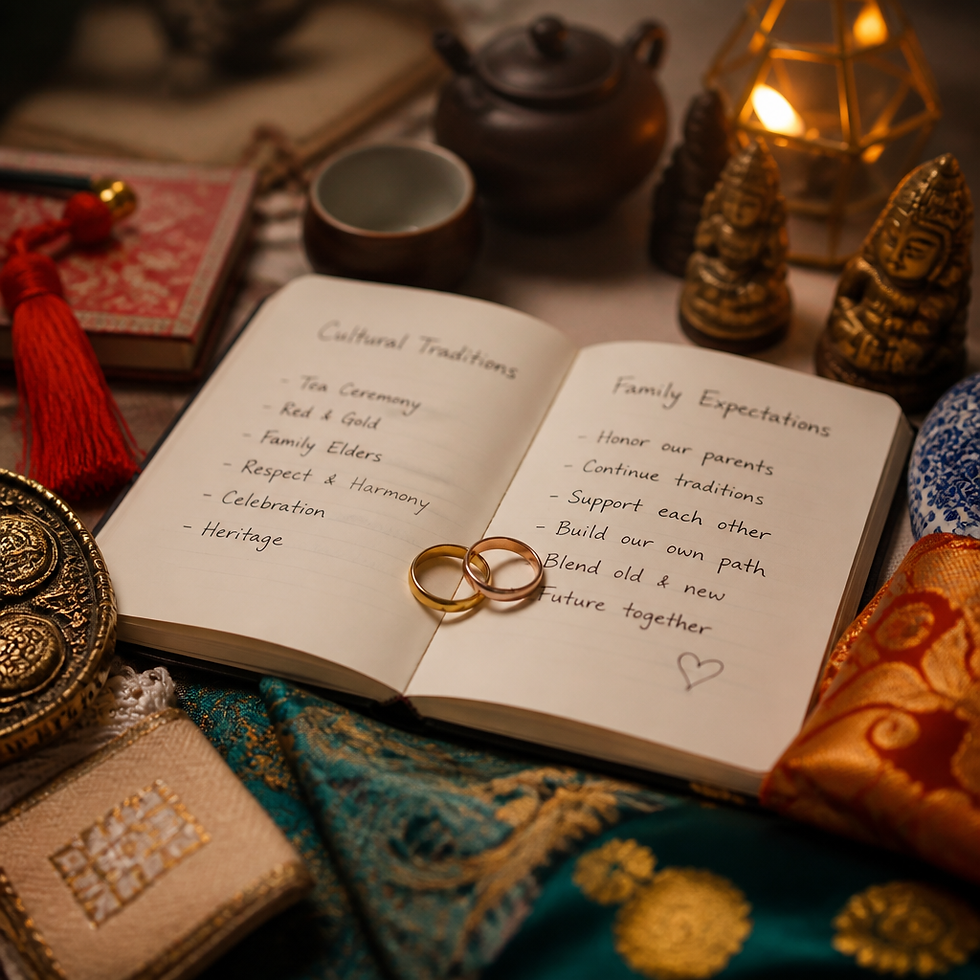
The Four Fault Lines in Singapore Intercultural Relationships
Across the couples seen in relationship coaching and marriage counselling work in Singapore, cultural friction tends to cluster around four recurring themes. Recognising which fault line is active in your relationship is the first step toward addressing it productively.
Collectivist versus Individualist Orientations
Many Asian cultures, including Chinese, Malay, and Indian communities in Singapore, lean collectivist: the needs of the family unit and extended clan carry significant moral weight. A partner raised in a more individualist framework, whether a Western-raised Singaporean or a foreign spouse from Europe or Australia, may interpret this as "you always put your parents ahead of me." The collectivist partner hears that as an attack on their fundamental sense of duty. Neither reading is wrong. Both are incomplete.
The practical danger is when couples treat this as a personality clash rather than a cultural script. You cannot argue someone out of their values by telling them their values are inconvenient. What you can do is build an explicit shared framework as a couple, one that both partners consciously agree to, rather than one that defaults silently to whoever is more assertive.
Face and Emotional Expression
Face-saving is a genuinely powerful force in Singapore's social fabric. For many partners from Chinese or Malay backgrounds, expressing anger, grief, or disappointment openly, especially in front of family, feels deeply wrong. A partner who was raised to "say what you feel" may interpret this restraint as dishonesty or emotional unavailability. In reality, it is a different, equally coherent emotional grammar. The gap between these two grammars is one of the most common drivers of the "you never talk to me" complaint in intercultural marriages here.
Pro tip: I suggest instead of asking your partner to "be more open," ask them to describe the feeling in terms of what they need. "I need more time before I can talk about this" is a sentence most people can say regardless of cultural background. It shifts the conversation from emotional style to practical need.
How Communication Styles Create Invisible Walls
Communication is consistently identified as a primary factor in the success of intercultural marriages, and the challenge goes well beyond language. Even when both partners are fluent in English, they may be operating with entirely different assumptions about what a conversation is for. Is it to arrive at a decision? To process feelings together? To show respect through listening without responding? All of these are legitimate cultural models, and they are not compatible by default.
A common pattern in Singapore intercultural couples is what practitioners sometimes call the directness mismatch. One partner, often from a Northern European, Australian, or American background, or from certain professional contexts, values explicit, direct communication: say the problem, name the need, propose the solution. The other partner, often from an East Asian or Southeast Asian background, communicates indirectly, expecting the other to read context, tone, and implication. When the indirect partner hints at dissatisfaction and the direct partner genuinely does not pick it up, the indirect partner does not conclude that their partner missed the cue. They conclude that their partner does not care enough to notice.
The deepest communication failures in intercultural marriages are not about words. They are about what each partner assumes the other already knows.
Language barriers add another layer. When one partner is communicating in their second or third language, they lose not just vocabulary but emotional nuance. Anger sounds flat. Sadness sounds like complaint. Affection sounds formal. This is not a deficiency; it is a structural limitation that both partners need to account for, deliberately and without blame.
Pro tip: I advise schedule a monthly "culture check-in" conversation, a low-stakes time to discuss anything that felt confusing or hurtful in the past few weeks and to genuinely ask: "Was that a me thing, or a cultural thing?" The question itself reduces defensiveness and builds curiosity.

Navigating Family and In-Law Dynamics
Research on intercultural marriages, including studies conducted in Singapore's specific context, repeatedly identifies family as the single most commonly reported source of conflict. This makes sense. You choose your partner. You do not choose your partner's family, and you cannot easily renegotiate what your partner was taught to owe them.
The In-Law Loyalty Bind
When a Chinese-Singaporean husband's mother expects to be consulted on major household decisions, and his Eurasian wife expects those decisions to be made as a couple, privately, neither expectation is unreasonable within its own cultural frame. But both cannot be the operating norm. The husband is caught in a loyalty bind that has nothing to do with how much he loves his wife. His wife feels excluded in a way that has nothing to do with how much he respects her. Without a deliberate, agreed-upon framework, this bind tends to get resolved by default, usually in favour of whoever applies more pressure.
The work here is not to cut off the in-laws or to demand the spouse "choose." That framing is both culturally illiterate and practically counterproductive in Singapore, where multigenerational ties are deeply woven into daily life. The work is to build a couple identity strong enough to hold its own alongside those ties, not instead of them.
Festivals, Obligations, and "Whose House Do We Go To"
The distribution of holidays and family time is a recurring flashpoint in Singapore intercultural marriages, particularly when one partner is non-local. Christmas, Chinese New Year, Deepavali, Hari Raya: each carries its own set of obligations, food rituals, and unspoken expectations about attendance and effort. A partner who is far from their own family may feel these obligations as doubly isolating. A practical, written calendar that gives each family's key events equal weight, agreed upon before the festive season begins, sounds banal. It is not. It prevents the same argument from recurring every single year.
Religion, Rituals, and Raising Children
Religion and parenting represent the two topics that intercultural couples most often avoid discussing in depth before marriage, and the two topics that cause the most damage when left unresolved after it. In Singapore, where religious identity intersects with ethnicity, legal frameworks, and community belonging, the stakes are especially concrete.
Religious Identity in an Interfaith Marriage
Interfaith marriages in Singapore carry specific legal implications, particularly for Muslim-non-Muslim couples, where one partner may be required to convert under the Administration of Muslim Law Act. Even outside this context, religious differences shape daily life in ways couples underestimate: dietary restrictions, prayer times, what you can and cannot do on certain days, how grief and death are handled. These are not just private spiritual matters. They are practical, recurring, visible in every shared meal and every conversation with in-laws.
What couples need is not necessarily agreement on theology. They need a shared, explicit understanding of how religious practice will work in their household, one that has been actually discussed and not just assumed.
Parenting Across Cultural Expectations
The first child is the moment when every unresolved cultural negotiation lands on the table simultaneously. What language will the child speak at home? Will they attend a religious school, a secular one, or both on alternating weeks? Is discipline physical or not? How much involvement does the extended family have in daily care? How do you handle a grandparent who undermines your parenting choices because "that is how we did it"?
These are not questions with universal right answers. But they are questions that need explicit answers, agreed between the couple, before the child arrives. Couples who enter parenthood with these conversations still pending do not find that the child's presence makes them easier. They find the opposite.
Comparing Approaches to Intercultural Relationship Work
There is no single method that suits every intercultural couple. The right approach depends on where the friction is concentrated, how long it has been unaddressed, and what kind of intervention the couple is willing to engage with. The table below compares three approaches commonly used in Singapore relationship and marriage counselling contexts.
Approach | Best Suited For | Limitations |
|---|---|---|
Structured Couples Counselling | Couples with established communication breakdowns, recurring arguments, or emotional disconnection stemming from cultural misalignment. Provides a neutral space to name and work through specific cultural scripts. | Requires both partners to be willing to examine their own cultural assumptions, not just point to the other's. Can feel slow for couples in acute crisis. |
NLP and Hypnotherapy-Integrated Coaching | Couples or individuals where cultural conditioning has created deep emotional blocks, fear of conflict, or ingrained patterns of withdrawal. Addresses the root-level beliefs, not just the surface behaviours. | Less suited as a standalone approach for couples who need structured communication skills first. Works best alongside direct coaching sessions. |
Psychoeducation and Self-Directed Work | Couples in relatively early stages of friction who are motivated and self-aware. Books, reflective exercises, and guided self-assessment can build cultural literacy before problems become entrenched. | Insufficient when emotional wounds are already present. Self-directed work tends to stall when the topic is painful enough that both partners avoid it. |
In practice, the most effective work for intercultural couples in Singapore combines all three in sequence: start with psychoeducation to build shared vocabulary, move into structured counselling to address specific fault lines, and use NLP or hypnotherapy-informed tools to dissolve the deeper emotional patterns that prevent the intellectual understanding from becoming lived change.
When to Seek Marriage Counselling in Singapore
One of the most persistent myths about marriage counselling in Singapore is that it is for couples who have already decided to separate. The opposite is closer to the truth. Couples who seek support early, when cultural friction is creating confusion and disappointment but has not yet curdled into contempt, have significantly more to work with. Contempt is the marker that something has shifted from "we have a problem" to "I have lost respect for you," and that shift is much harder to reverse.
Specific signs that an intercultural couple would benefit from professional support include: arguments that repeat without resolution, a sense that your partner is fundamentally unknowable or unreachable, withdrawal from physical or emotional intimacy without either partner naming it directly, feeling consistently judged by your partner's family with your partner's silent acquiescence, and dread about bringing up cultural topics because the last time ended badly.
What Effective Support Actually Looks Like
Effective relationship support for intercultural couples is not a generic communication skills workshop. It requires a practitioner who understands Singapore's specific cultural landscape, including the weight of face-saving, the structure of Chinese, Malay, and Indian family obligations, the legal and religious dimensions of interfaith marriage here, and the particular pressures faced by transnational couples managing distance from one partner's family of origin.
At my work space, Lady SC, the approach integrates over 20 years of experience with Singapore-based couples, combining professional coaching, NLP techniques, and hypnotherapy to address both the conscious communication patterns and the deeper emotional conditioning that drives them. Sessions are available in person and online, with WhatsApp support between sessions to address real-time challenges as they arise, rather than waiting for the next scheduled appointment. For couples navigating cultural differences, that continuity matters. Cultural conflicts do not wait for scheduled slots.
The goal is not to erase the cultural differences between partners. It is to build a couple identity robust enough to hold those differences without one partner feeling perpetually like the outsider in their own marriage.
Frequently Asked Questions
Is a multicultural marriage harder to sustain than a same-culture marriage in Singapore?
Not inherently harder, but it does require more explicit negotiation. Same-culture couples share a set of unspoken assumptions that reduce friction in the early years. Intercultural couples need to build their shared framework consciously rather than inherit one. Couples who do this work, particularly early in the relationship, report strong, durable partnerships. The difficulty is not in the cultural difference itself but in the assumption that love alone will make the differences irrelevant.
What are the most common cultural clashes in Singapore intercultural relationships?
The most consistently reported friction points are: family obligation and in-law involvement, communication styles including directness versus indirectness and face-saving behaviour, differing approaches to parenting and discipline, religious practice and its role in daily household life, and different assumptions about financial management, including how much goes to parents or extended family. In Singapore's transnational marriages, physical distance from one partner's family of origin adds an additional layer of isolation and guilt.
How do we handle in-law pressure when our cultures have very different expectations of family loyalty?
The key is to establish a clear couple identity before managing the extended family, not after. This means agreeing, between yourselves and explicitly, on what decisions you make as a couple independently, what you consult family on, and what boundaries apply to both sets of parents equally. The boundary must apply to both sides or it will feel like an attack on one partner's culture. Presenting a united front to in-laws does not mean being cold or disrespectful. It means your family unit has its own integrity.
When is the right time to start marriage counselling for cultural issues in Singapore?
The right time is before the same argument happens a third time without resolution. Many couples wait until they are in acute crisis, but by that point the emotional accumulation makes the work harder and longer. If you notice that a particular cultural difference is creating a recurring pattern of hurt, withdrawal, or resentment, that is the signal. Pre-marital counselling for intercultural couples is also strongly advisable, particularly on topics like parenting, religion, and in-law expectations, which couples routinely avoid discussing before the wedding.
Can online marriage counselling work for intercultural couples in Singapore?
Yes, and for transnational couples or couples where one partner travels frequently, it is often the only format that provides consistent support. The quality of the therapeutic relationship matters far more than the delivery format. Online sessions allow for the same depth of conversation and the same structured interventions as in-person work. The addition of WhatsApp support between sessions is particularly valuable for intercultural couples because cultural friction tends to arise in specific real-world moments, such as a family dinner or a parenting disagreement, and the ability to address it immediately is more effective than reconstructing it weeks later in a session.
Do both partners need to attend counselling, or can one person go alone?
Both formats are valid and serve different purposes. Individual coaching or counselling helps one partner understand their own cultural conditioning, emotional patterns, and communication style more clearly, which always improves the relationship regardless of whether the other partner participates. Couples sessions allow the practitioner to work directly with the dynamic between both partners. Ideally, both are used. In practice, it is common for one partner to start individually and for the other to join once they see the change it produces.
If you are navigating a multicultural marriage or intercultural relationship in Singapore, share what has been the most surprising cultural difference you have had to work through as a couple. Your experience might resonate with someone reading this who feels alone in theirs. Contact me for the matter.



Comments