
Relationship Coaching Follow-Up: Why It Drives Lasting Change
Updated: Sep 15
I noticed most couples leave a coaching session feeling genuinely hopeful. They have new language for old arguments, clearer insight into each other's needs, and a plan they both believe in. Then real life resumes. Within two weeks, the same argument erupts, the same emotional withdrawal kicks in, and the breakthrough starts to feel like a distant memory. This is not a failure of the session. It is a predictable gap that relationship coaching follow-up is specifically designed to close. Without structured ongoing support, even the most powerful insights tend to fade, old patterns reassert themselves, and couples quietly conclude that change is not possible for them. That conclusion is wrong, and this article explains why.
Why Insights Alone Do Not Create Lasting Change
There is a seductive idea in coaching circles that one profound realization is enough to change a person. It is rarely true, and in relationship work, it is almost never true, because you are not changing one person. You are changing two people whose patterns interact with each other in real time, under real pressure, with real history.
A coaching session produces what practitioners call an "isolated insight." You see clearly, perhaps for the first time, that your withdrawal during conflict is interpreted by your partner as contempt rather than self-protection. That is valuable. But the next time conflict arises, your nervous system does not consult your new insight. It runs the program it has been running for years.
Lasting change in relationships requires that new responses be practiced until they become the default, not the deliberate exception. That process takes time and repetition far beyond a single session or even a short series of sessions. Without follow-up support built into the coaching structure, couples are left to manage that process entirely on their own, usually at the moments when they are least equipped to do so.
Pro tip: I suggest after any coaching session, write down one specific behaviour you agreed to practice before the next check-in. Not a feeling or an intention. A behaviour, one that both partners can observe and name.

What Relationship Coaching Follow-Up Actually Looks Like
Follow-up support is not simply booking another session two months later and hoping things held together. That is the minimum. Effective relationship coaching follow-up is a structured layer of contact that exists between sessions, not just at them.
Scheduled Check-In Sessions
These are shorter, focused sessions that typically happen once every two to four weeks after an intensive initial period. Their purpose is not to cover new ground but to review what was committed to, explore what happened with incomplete commitments, and identify patterns across sessions. A good coach treats a broken commitment as information, not a failure.
For couples in Singapore juggling demanding work schedules, school drop-offs, and family obligations, monthly or bi-monthly check-ins are a practical way to maintain momentum without the pressure of weekly full sessions. The key is that they happen on a fixed schedule, not only when things fall apart.
Between-Session Support Channels
This is where many coaching practices in Singapore fall short. Couples do not have their arguments on schedule. A conflict at 10pm on a Wednesday does not wait until your next appointment. A coach who offers only formal sessions leaves clients unsupported precisely when support matters most.
At my work space, Lady SC, WhatsApp support between sessions is built into the practice model. This is not about the coach solving every problem by text. It is about having a trusted contact point where a couple can say "we are having a hard week" and receive specific, grounded guidance rather than sitting with rising anxiety until the next scheduled hour.
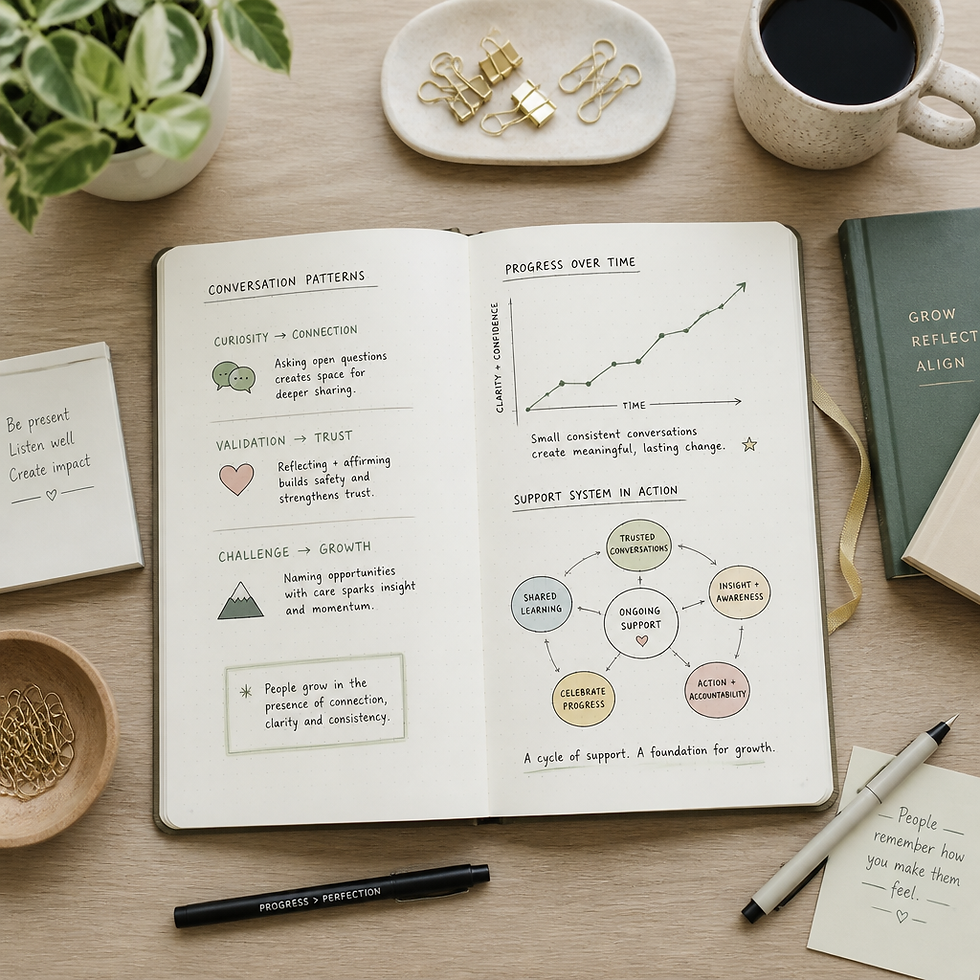
Sustainable progress in relationships does not come from a single breakthrough. It comes from a long series of smaller corrections, each one reinforced by support that meets couples where the real difficulty happens, which is in daily life, not in a coaching room.
Practical Tools Between Sessions
Ongoing support also works through what couples take home. Communication worksheets, reflection prompts, and structured daily practices give the work a container between formal sessions. The coach's job is to assign these with enough specificity that couples know exactly what they are practicing and why, and to follow up on them, not just issue them and move on.
The Neuroscience Behind Lasting Change in Relationships
The science of why follow-up matters is not complicated, though it is frequently ignored in the coaching industry's enthusiasm for transformation.
Each time you respond differently to a familiar trigger, you begin strengthening a new neural pathway. Over time, with consistent repetition, that new pathway can become the more automatic route. This is neuroplasticity working in your favour. The problem is that without repetition, the old pathway remains dominant. One coaching session cannot override years of ingrained relational habits. Repeated, supported practice can.
Research published in the European Journal of Social Psychology on habit formation found that the timeline for reliably integrating a new daily behaviour varied from 18 to 254 days depending on the individual and the complexity of the behaviour. Relational habits are among the most complex and emotionally loaded behaviours humans engage in. Expecting them to shift permanently after two or three sessions, with no follow-up, is not just optimistic. It is structurally unrealistic.
NLP techniques and hypnotherapy, as used at my work space, Lady SC, work precisely because they operate at the level where these patterns are stored, below conscious decision-making. But even these approaches are more effective when followed up. A technique that shifts a limiting belief in session needs to be anchored and reinforced in real-world contexts for the change to hold under stress.
Pro tip: I recommend the moments when you feel most tempted to revert to old patterns, usually during conflict or stress, are exactly when new skills feel hardest to use. Tell your coach specifically what those triggers are so follow-up support can be built around them.

The Role of Accountability in Relationship Change
Accountability in relationship coaching is often misunderstood. It is not about checking up on people or making them feel guilty for slipping. Done well, it is about creating a structure that makes it easier to follow through on commitments than to abandon them quietly.
When a couple knows that at their next check-in they will be asked specifically what happened with the communication practice they committed to, they are more likely to actually attempt it. Not because they fear judgment, but because the commitment has weight. It exists in relationship to someone outside the couple, not just between two people who are also dealing with the emotions at stake.
A common mistake in self-directed relationship improvement is that commitments made in the heat of a productive session do not survive contact with a difficult week. The energy dissipates, life crowds in, and the commitment is quietly shelved. Follow-up support interrupts that pattern by treating incomplete commitments as data, not proof that the work is not working.
Accountability Is Not the Same as Pressure
A skilled coach distinguishes between accountability that empowers and accountability that shames. If a couple did not manage the communication exercise they planned, the follow-up question is not "why didn't you do it?" It is "what got in the way, and what does that tell us about what the real obstacle is?" That conversation is often more valuable than the exercise itself.
This is also where the combination of coaching modalities at Lady SC adds practical value. NLP-based approaches help identify the internal patterns, including limiting beliefs and unconscious emotional responses, that explain why a straightforward commitment keeps failing. Hypnotherapy can address those patterns at a deeper level than talk alone. Follow-up support then tracks whether those shifts hold in the real relational environment.
How Lady SC Structures Ongoing Support
Over more than 20 years of practice, the approach at my work space, Lady SC, has evolved around a central observation: the work done in a session is preparation for the work done in daily life. Sessions are where the insight happens. The space between sessions is where the change either takes root or gets lost.
The ongoing WhatsApp support model built into my, Lady SC's practice is not an add-on. It is a recognition that couples in Singapore face a specific set of pressures, work culture, family expectations, financial stress, and limited time together, that make real-world relational practice genuinely difficult. Having access to a coach between sessions means that when a couple hits a flashpoint, they have somewhere to turn that is not just each other or silence.
This is what separates a practice designed for lasting change in relationships from one designed for weekly appointments. The goal is not to keep couples in ongoing sessions indefinitely. It is to support them through the phase when new patterns are most vulnerable, until those patterns are stable enough to sustain themselves.
Whether you are working through a communication breakdown, rebuilding trust after a rupture, or addressing the emotional distance that has grown over years, the support structure around the sessions matters as much as the sessions themselves. Explore the full range of services at my work space, Lady SC, to understand how this is built into every engagement, including marriage counselling and couples coaching options designed for where you actually are.
Common Objections to Ongoing Coaching Support
Several objections come up repeatedly when couples are weighing whether to commit to follow-up support beyond an initial session or short series. Most of them deserve a direct answer.
"We Made Progress. We Should Be Able to Manage from Here."
This is the most common one, and it usually surfaces right at the point when couples feel good after productive sessions. The feeling of readiness is real. The risk is that it gets tested immediately by the next difficult conversation or stressful week. Progress made in a coaching context needs to be transferred to daily life, and that transfer is where most couples struggle without support. Feeling ready and being consolidated are different things.
"Ongoing Support Feels Like Dependency."
Structured follow-up has a clear endpoint. It is not indefinite therapy or a relationship with no exit. The goal of good follow-up is to make itself unnecessary by building the couple's own capacity to navigate difficulty. A relationship coach Singapore worth working with is actively working toward handing the tools over, not keeping you reliant on external support.
"We Do Not Have Time for More Sessions."
Follow-up support does not always mean additional full sessions. It can mean a 20-minute check-in call, a specific WhatsApp exchange about a situation that came up, or a short reflective exercise assigned for a particular week. The format adapts to the couple's life, not the other way around.
Frequently Asked Questions
How long should relationship coaching follow-up last?
`
There is no universal answer, but most couples benefit from structured follow-up for at least two to four months after an intensive initial phase. The timeline depends on how entrenched the patterns are, what external stressors the couple is navigating, and how quickly new habits are consolidating in real daily life. A good coach assesses this regularly rather than applying a fixed duration.
Is WhatsApp support between coaching sessions actually effective?
Yes, when it is used purposefully. The value is not in having endless access to a coach for reassurance. It is in having a specific, trusted point of contact when a couple faces a real-time situation that their new skills have not yet fully handled. A brief, grounded response from a coach in that moment can prevent a small setback from becoming a significant regression. It is particularly relevant in Singapore, where busy schedules
make waiting until the next formal session impractical.
What is the difference between follow-up coaching and therapy?
Follow-up coaching focuses on implementation and accountability. It builds on agreed-upon goals and tracks progress against them. Therapy, particularly with clinical practitioners, may address deeper psychological issues and is structured differently. Some practices, including mine, Lady SC, use a blend of coaching, NLP, and hypnotherapy that addresses both the behavioural and the deeper emotional dimensions. The follow-up component is primarily about ensuring that what was worked on in sessions becomes part of how the couple actually lives.
Can follow-up support help even if we feel we are doing well after sessions?
Especially then. The couples who drop follow-up support when things feel good are often the same couples who return months later having slipped back to earlier patterns. The period of feeling good is actually the optimal time for consolidation work because both partners are motivated and the new patterns are active. Follow-up at this stage reinforces what is working and prepares the couple for the inevitable stress periods ahead.
Does online coaching with follow-up work as well as in-person sessions?
For most couples, online coaching with structured follow-up is as effective as in-person sessions, provided the coach offers genuine personalised engagement rather than generic resources. The format is less important than the quality and consistency of the support. Many couples in Singapore prefer the flexibility of online sessions combined with WhatsApp between-session contact, which means follow-up can happen without the logistics of travel and scheduling.
How is Lady SC's approach to follow-up different from other coaching practices?
Most coaching practices in Singapore offer sessions. Follow-up is either informal or left entirely to the couple. I, Lady SC, build between-session WhatsApp support directly into the engagement model, treating it as a core component of the work rather than an optional extra. Combined with techniques from NLP and hypnotherapy that address patterns at a deeper level than conversation alone, the follow-up support at my work, Lady SC is designed to track whether those shifts are actually holding in the couple's real environment, and to intervene specifically when they are not.
If any of this reflects what you have experienced after previous coaching or therapy, share your story in the comments. It helps other couples in Singapore know they are not alone, and it shapes how practitioners think about what support actually needs to look like. Contact me for the matter.



Comments